Finding and monitoring workflow runs
After a workflow executes, Flow provides a log of what happened, called a workflow run, that allows you to monitor its performance and behavior.
On this page
Accessing workflow runs
You can monitor all workflow runs in the Flow app. Reviewing workflow runs can help you identify potential issues with the workflow's behavior.
You might want to review runs across all workflows when you're troubleshooting or not sure which workflow to check. If you know specifically which workflow that you want to review, then you can access the recent runs for only that workflow.
Steps:
Review all workflow runs
From your Shopify admin, go to Apps > Flow.
Click Recent runs.
Optional: Click a specific run to review the details.
Review workflows runs for a specific workflow
From your Shopify admin, go to Apps > Flow.
Select the workflow with runs that you want to review.
In the Recent runs section, review the runs listed.
Optional: Click a specific run to review the details.
Searching for a specific workflow run
You can search for workflow runs in Flow using any of the following methods:
- From resource pages in the Shopify admin, such as an order or product.
- From within the Flow app, you can filter the recent runs lists using the following common searching filters:
- By text in step data, such as a customer ID or order ID.
- By time range, such as the date and time that the run should have happened.
What can be searched
The Recent runs list in the Flow app contains the option to filter the entire list of runs by any combination of the following filters:
- Includes text: Filter by the raw text contents of the data used in the workflow run, such as an order ID in a trigger payload, or the tag name in a condition.
- Workflows: Filter by the name of the workflow.
- Actions taken: Filter by whether the run took any actions (true) or did nothing (false).
- Errors: Filter by whether the run contains errors.
- Start time: Filter by a date and time range when the run should have started. Learn more about filtering runs by time.
- Trigger type: Filter by how the run started. Options include a trigger event, manual run, or a manual retry.
- Retry status: Filter by whether the run contains retries or not.
- Run ID: Filter by a specific run ID. You can also opt to include retries related to a specified run ID.
- Tags: Filter by which workflow tags apply to the run.
Before searching, consider what information you can search in the workflow run. This information is displayed inside the workflow run details and includes the following types:
- Any IDs for resources that were used in the workflow run, such as order IDs or customer IDs.
- Any text or data that was included in the workflow run, such as a tag name or product title.
In addition, when searching for a workflow run, consider the following limitations:
- The search is case-insensitive.
- The search string shouldn't include punctuation. For example, if you're searching for an order ID, then search
43843493instead ofgid://shopify/Order/43843493. - The logs don't contain all the details about resources used in your workflow. For example, if you use a product ID in your workflow, then the workflow run log doesn't contain the product name or title unless you also used those fields.
- The search is limited to the last 14 days of workflow runs.
Search from the Shopify admin
For resources that have a More actions menu, you can initiate a workflow run search by choosing the Search Flow runs option. This option is available for the following resources:
- Orders
- Draft orders
- Customers
- Products
- Variants
- Collections
If you have trouble finding a run, then review what can be searched.
Steps:
- In the Shopify admin, open the resource that you want to search for, such as an order or product.
- Click More actions.
- Click Search Flow runs.
Search by text in step data
In the Flow app, you can search for any data that was included in the step data sections in a workflow run.
If you have trouble finding a run, then review what can be searched.
Steps:
- In the Flow app's Recent runs list, click Add filter.
- Choose Includes text.
- Enter the text or ID to search for.
Search by time range
Review the following considerations for finding a workflow run by time range:
- Dates and times for workflow runs are displayed in your store's time zone, not in the time zone of your device. To confirm the time zone that a time is displayed in, hover over the time.
- The Start time filter also uses your store's time zone, so the times that you enter match the times that are displayed in the Recent runs list.
- In high-volume stores, you might need to use a narrow time range and other filters to make it easier to find a specific workflow run.
- Workflow runs are stored for only 14 days after the run completes.
- There might be a delay between when a workflow runs and when its results display on the Recent runs page. If the results for a recent workflow aren't available yet, then wait a few minutes and try again.
Steps:
- In the Flow app's Recent runs list, click Add filter, and then click Start time.
- In the From field, enter a date and time that is equal to the time that the event should have happened. For example, for an Order created trigger, use the time that the order was created. Ensure that you enter the correct
AM/PMvalue. - In the To field, enter a date and time that is 10 minutes after the From date and time.
- Review the search results. Workflows typically run at exactly the same time as a triggering event or shortly afterwards.
- Click a result that matches the time and verify that the displayed resource matches the resource that you're looking for, such as the order.

Columns in the recent runs list
A workflow's recent runs list displays key data about the workflow runs:
| Column | Description |
|---|---|
| Start time | The time the workflow run began, displayed in your store's time zone. |
| Run status |
|
| Results | List of actions completed and a list of errors by step. |
| Retries | If the run was retried, then a link to the list of retries is provided. |
| Trigger type |
|
Viewing the details for a workflow run
To access detailed information about an individual workflow, click the row for the workflow run.
At the top, the Status section indicates whether the workflow was completed. The Actions section indicates how many actions in the workflow ran successfully.
The Details section displays a preview of the workflow and highlights the path(s) that the workflow took.

After the workflow preview, you can view the results, logs, and data for each step in the workflow.

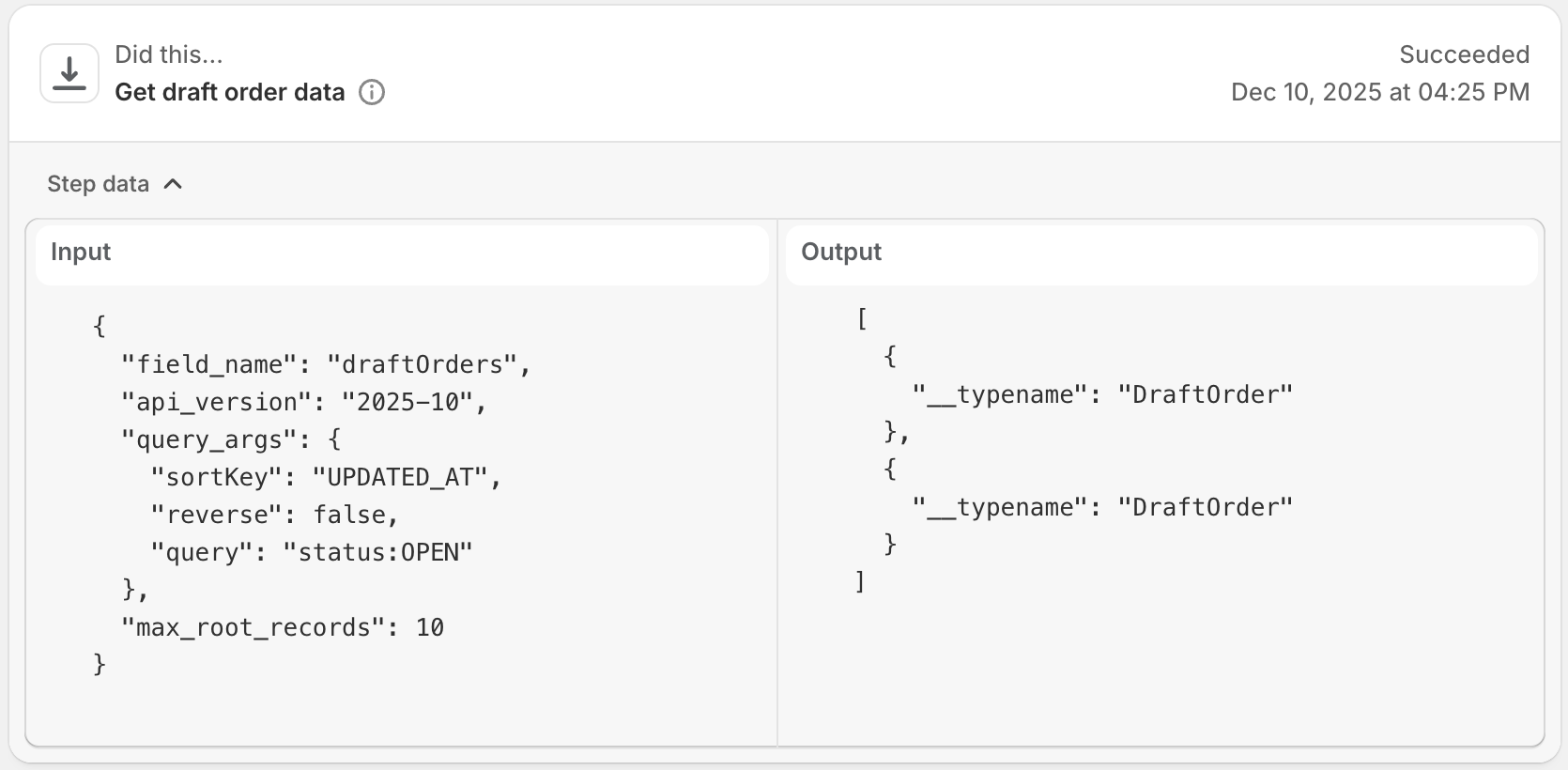
For each step, you can expand the Step data section to view the data that was used in the workflow run. This data includes any IDs for resources that were used in the workflow run, such as order IDs or customer IDs, and any text or data that was included in the workflow run, such as a tag name or product title.
Workflows with 'For each loop' actions
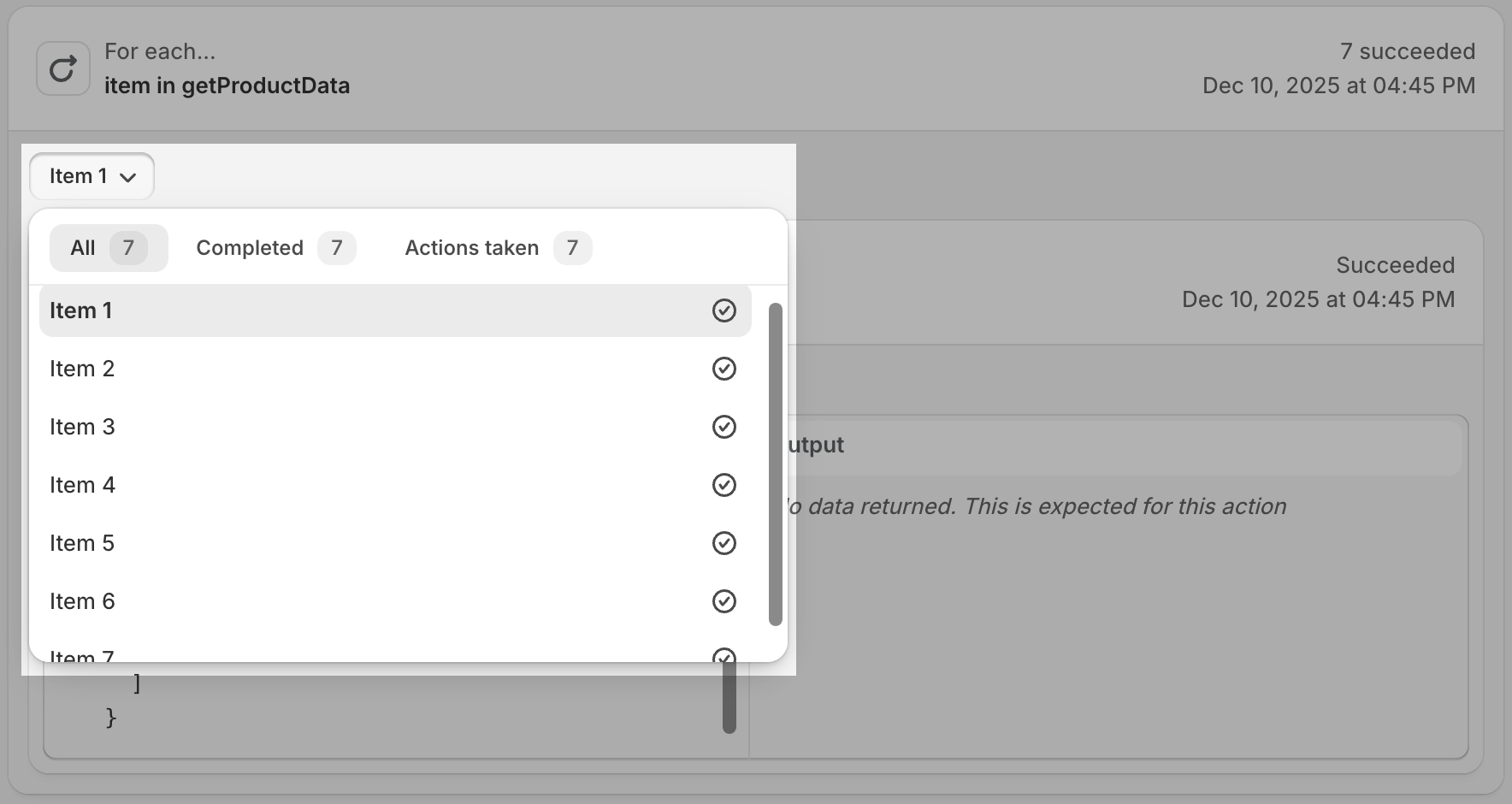
Workflows that include the For each loop (iterate) action repeat steps several times. Flow highlights how many items followed a path in the workflow preview.

Flow also displays the results from each loop iteration and allows you to filter by actions taken and errors in order to quickly troubleshoot loops.
Canceling in-progress workflow runs
You can cancel a workflow run with a status of In progress or Rate limited when you want to stop a workflow before it completes. Canceling a workflow run can be a useful option to avoid hitting API limits, when you notice that the workflow isn't running as intended, or from failing runs cluttering your Recent runs list.
Considerations for canceling in-progress workflow runs
Before canceling an in-progress workflow run, review the following considerations:
- You must use a desktop device to cancel workflow runs in the Flow app.
- You can't cancel runs that have already completed.
- Canceled runs can't be resumed at a later time. If you need the workflow to run again, then you can wait for the workflow to trigger automatically, retry the run, or start a new workflow run manually.
- Canceling workflow runs doesn't automatically turn off the associated workflow. However, turning off a workflow does automatically cancel all of its in-progress workflow runs.
- Workflow runs can take between a few seconds to a minute to cancel, depending on the complexity of the workflow.
Cancel in-progress workflow runs
You can cancel an in-progress workflow run at any time. There are multiple ways to cancel in-progress workflow runs:
- To cancel a specific run, you can cancel from the workflow run's details page directly.
- To cancel multiple runs for a single workflow, you can cancel runs in bulk from the workflow's Recent runs list.
Steps:
Cancel a specific run of a workflow
From your Shopify admin, go to Apps > Flow.
Click the workflow with the in-progress run that you want to cancel.
In the Recent runs section, click the in-progress run that you want to cancel.
Click Cancel.
Cancel multiple runs for a workflow
From your Shopify admin, go to Apps > Flow.
Click the workflow with the in-progress run that you want to cancel.
In the Recent runs section, select all of the in-progress runs that you want to cancel.
Click Cancel run.
Troubleshooting workflow runs
In some cases, a workflow run can encounter an error or not run as intended. Most commonly, this occurs when there is a configuration issue with the workflow. Learn more about troubleshooting Flow errors and retrying workflow runs to retroactively fix the result of past runs.